
Lexicon MX200 Manual: A Comprehensive Guide
Welcome! This detailed guide expertly navigates all aspects of the Lexicon MX200, ensuring optimal performance and a maximized user experience, alongside crucial service information.
This manual provides comprehensive instructions, covering setup, operation, troubleshooting, advanced techniques, and essential maintenance procedures for your Lexicon MX200 unit.
It also details compatibility with SimBrief and flight simulators, alongside hardware and software specifications, and resources for authorized repair centers.
The Lexicon MX200 represents a significant advancement in audio processing technology, offering musicians and audio engineers a versatile tool for live performance and studio applications. This manual serves as your complete resource for understanding and utilizing the full potential of this powerful device. Originally released in 2006, the MX200 continues to be a valued piece of equipment, though battery issues may arise with older units.
This guide will walk you through everything from initial setup and connecting power to exploring advanced editing options and integrating with flight simulators like SimBrief, powered by Navigraph’s navigational database. We’ll cover basic operation, effects parameters, preset creation, and troubleshooting common issues, including power-on problems and audio output concerns.
Proper maintenance, including cleaning and recommended service intervals, will also be addressed, alongside resources for locating authorized repair centers. This manual aims to empower you to confidently operate and maintain your Lexicon MX200 for years to come.
What is the Lexicon MX200?

The Lexicon MX200 is a professional-grade multi-effects processor designed for vocal and instrument processing. It’s a compact, rack-mountable unit renowned for its high-quality Lexicon effects, including reverb, delay, chorus, and more. Originally intended for musicians, its versatility extends to applications like live sound reinforcement and recording studios.
The MX200 boasts a user-friendly interface, allowing for intuitive control over a wide range of parameters. While initially shipped with a battery for portable use, older units may experience battery failure requiring service or replacement. It’s compatible with various operating systems, including Windows XP (Service Pack 2 or higher).
Furthermore, the MX200’s integration with SimBrief, utilizing Navigraph data, expands its functionality into the realm of flight simulation. This manual will guide you through harnessing its capabilities, ensuring you maximize its potential for both musical and specialized applications, including potential repair needs.
Key Features and Specifications
The Lexicon MX200 delivers studio-quality effects in a convenient, rack-mountable format. Key features include a comprehensive library of Lexicon’s renowned reverb, delay, chorus, flanger, and pitch-shift algorithms. It offers extensive editing capabilities, allowing users to sculpt sounds to their precise specifications.
Specifications include a 24-bit A/D and D/A converters, ensuring high fidelity audio processing. The unit supports various input/output configurations, enhancing its versatility. It’s powered by an internal battery, though older models may require service due to battery degradation.
Software and firmware versions are crucial for optimal performance and compatibility. The MX200’s compatibility extends to flight simulators via SimBrief, leveraging Navigraph’s navigational data. Detailed hardware specifications and repair information are available in this manual and from authorized service centers.
Setting Up Your Lexicon MX200
Proper setup is crucial! This section details unboxing, power/audio connections, control panel understanding, and menu navigation for seamless operation.
Unboxing and Initial Inspection
Carefully unpack your Lexicon MX200, verifying all components are present. The package should include the MX200 unit itself, a power adapter, and this owner’s manual. Inspect the unit thoroughly for any physical damage incurred during shipping – dents, scratches, or broken connectors.
If damage is evident, immediately contact the retailer or shipping carrier to initiate a claim. Retain all packaging materials for potential returns or warranty service. Before connecting power, visually confirm the unit’s ports are free from debris.
Check the battery compartment (if applicable) for signs of corrosion, especially if the unit is pre-owned, as noted in some user reports. A compromised battery may require immediate replacement. Ensure all included accessories match the documentation.
Connecting Power and Audio
Connect the provided power adapter to the MX200’s power input and a suitable AC outlet. Ensure the voltage matches the unit’s requirements to prevent damage. For audio connections, utilize standard ¼-inch cables. Connect your audio source (mixer, instrument, etc.) to the MX200’s input jacks, and the outputs to your amplifier or recording interface.
Be mindful of impedance matching for optimal signal transfer. If experiencing issues, verify cable integrity and proper port selection. Some users have reported needing to disable the “Lexicon MX200 Control” port within application settings to resolve connectivity conflicts.
Always power on the audio source before the MX200 to avoid potential pops or noise. If liquid spills occur, immediately disconnect power and seek professional service.
Understanding the Control Panel
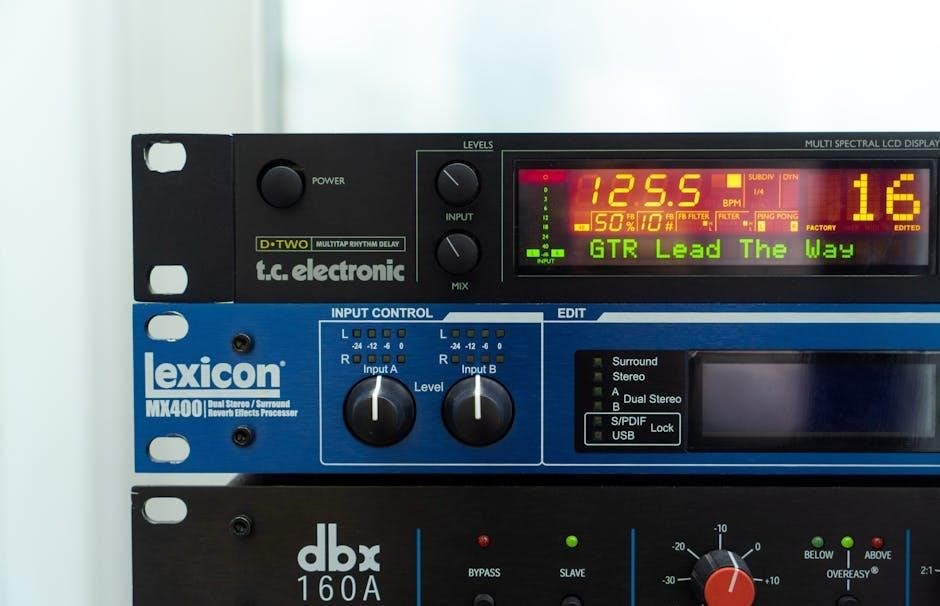
The Lexicon MX200’s control panel features a variety of knobs, buttons, and a display screen for parameter adjustment and preset navigation. Familiarize yourself with the function of each control before operation. The display provides visual feedback on selected settings and effect parameters.
Key controls include preset selection buttons, effect level knobs, and parameter adjustment encoders. Use the menu navigation buttons to access deeper editing options. The panel’s responsiveness is crucial; if experiencing sluggish behavior, consult the troubleshooting section.
Refer to the detailed diagrams within this manual for precise control identification. Proper understanding of the control panel is essential for unlocking the MX200’s full potential and achieving desired sonic results.
Navigating the Menu System
The Lexicon MX200’s menu system allows access to advanced settings and customization options. Utilize the dedicated menu navigation buttons – typically labeled ‘Enter’, ‘Up’, ‘Down’, and ‘Back’ – to traverse the hierarchical structure. The display screen clearly indicates the currently selected menu item and parameter values.
Menu sections include preset management, effect parameter editing, system settings, and utility functions. Be cautious when altering system settings, as incorrect configurations may affect performance. The menu is logically organized, but careful exploration is recommended.
If the control panel becomes unresponsive, refer to the troubleshooting section. Remember to save any changes before exiting a menu to prevent data loss; Mastering the menu system unlocks the full creative potential of the MX200.

Using the Lexicon MX200
Unlock its potential! Explore basic operations, understand effect parameters, create personalized presets, and seamlessly integrate the MX200 with SimBrief for enhanced experiences.
Basic Operation and Functionality
Powering On & Initial Setup: Ensure the Lexicon MX200 receives adequate power and is correctly connected to your audio system. Upon startup, the unit will initialize, displaying its main interface. Familiarize yourself with the control panel, noting the key buttons and knobs for parameter adjustments.
Navigating Presets: The MX200 comes pre-loaded with a variety of factory presets, accessible via the menu system. Use the navigation controls to scroll through these presets, auditioning different effects. Experiment with selecting various options to understand their sonic characteristics.
Real-time Adjustments: During operation, utilize the knobs and buttons to make real-time adjustments to effect parameters. Observe how these changes impact the audio signal, allowing for dynamic control and creative sound design. Remember to save any customized settings as new presets.
Understanding Signal Flow: The MX200 processes audio signals through a defined chain of effects. Understanding this signal flow is crucial for achieving desired results. Experiment with different routing configurations to explore the unit’s versatility.
Understanding Effects Parameters
Reverb Parameters: Explore parameters like ‘Decay Time’ controlling reverb length, ‘Pre-Delay’ adjusting the initial delay before reverb onset, and ‘Diffusion’ influencing reverb density. Adjust ‘Room Size’ to simulate different acoustic spaces, from intimate chambers to vast halls.
Delay Parameters: Manipulate ‘Delay Time’ for rhythmic echoes, ‘Feedback’ for echo repetition, and ‘Mix’ to blend the dry and wet signals. Experiment with ‘Modulation’ to add chorus-like effects to the delay.
Chorus & Modulation: Control ‘Rate’ and ‘Depth’ to adjust the speed and intensity of chorus or flanger effects. ‘Feedback’ can create swirling, psychedelic textures. Understand how these parameters interact to shape the overall sonic character.
EQ & Dynamics: Utilize built-in EQ to sculpt the frequency response of effects. Adjust ‘Threshold’ and ‘Ratio’ for dynamic control, adding punch or smoothing out transients. Careful parameter adjustments unlock the MX200’s full potential.
Creating and Saving Presets
Preset Creation: Begin by meticulously adjusting effect parameters – reverb, delay, chorus, and EQ – to achieve your desired sound. Experiment with combinations and subtle nuances to craft unique sonic textures. The MX200 offers extensive control for personalized sound design.
Saving Presets: Once satisfied, navigate to the ‘Save’ function within the menu system. Assign a descriptive name to your preset, ensuring easy recall. Utilize the preset memory locations to store a diverse library of sounds.
Preset Management: Regularly back up your presets to avoid data loss. Consider organizing presets by category – vocals, instruments, ambience – for efficient workflow. The MX200 allows for easy preset loading, editing, and overwriting.
Recall & Editing: Quickly recall saved presets during performance or recording. Further refine existing presets by making incremental adjustments, building upon your initial creations.
Utilizing the MX200 with SimBrief
Seamless Integration: The Lexicon MX200 enhances the flight simulation experience when paired with SimBrief, a popular flight planning tool. SimBrief provides detailed navigational data, compatible with numerous aircraft types – currently 192 are supported.
Data Synchronization: Ensure your MX200 is correctly configured to receive data from SimBrief. This typically involves establishing a connection through a virtual COM port, as detailed in the MX200’s connection settings.
Flight Plan Implementation: SimBrief’s generated flight plans, including waypoints and airways, can be utilized to create realistic audio cues within your simulation. This adds immersion and situational awareness.
Navigraph Support: SimBrief’s navigational database is powered by Navigraph, ensuring accurate and up-to-date information for a truly authentic flight simulation experience.

Troubleshooting Common Issues
Addressing Problems: This section provides solutions for powering on failures, audio output malfunctions, unresponsive controls, and battery concerns, ensuring optimal service.
Powering On Problems
Initial Checks: If the Lexicon MX200 fails to power on, first verify the power adapter is securely connected to both the unit and a functioning power outlet. Confirm the outlet is delivering power by testing it with another device.
Battery Issues: A depleted or damaged battery is a common cause. Given the unit’s age (referenced as a collapsed battery in 2006), the battery may require replacement. Acid leakage from a failing battery necessitates immediate shutdown and professional service.
Port Conflicts: In some cases, software conflicts can prevent proper recognition. Disconnect the MX200 Control port within application settings, as suggested in troubleshooting documentation, and attempt powering on again. Ensure Windows XP Service Pack 2 or higher is installed for optimal compatibility.
Internal Damage: If these steps fail, internal component failure is possible, requiring professional repair. Do not attempt self-repair if unfamiliar with electronics;
Audio Output Issues
Connection Verification: If experiencing audio output problems, meticulously check all audio connections. Ensure cables are securely plugged into both the Lexicon MX200 and your mixing console, amplifier, or recording interface. Test cables with known working alternatives to rule out cable failure.
Volume Levels: Confirm that volume levels on both the MX200 and connected devices are appropriately adjusted. Start with moderate levels and gradually increase to avoid clipping or distortion.
Software Settings: Within your recording software or DAW, verify the MX200 is selected as the correct audio output device. Check routing configurations to ensure signals are being sent to the intended outputs;
Internal Faults: Persistent audio issues may indicate an internal hardware problem requiring professional service or repair. Avoid attempting internal repairs without proper expertise.
Control Panel Responsiveness
Initial Reset: If the control panel becomes unresponsive, attempt a soft reset by powering the Lexicon MX200 off and then on again. This often resolves temporary software glitches.
Firmware Check: Ensure you are running the latest firmware version. Outdated firmware can sometimes cause control panel instability. Refer to the Lexicon website for firmware updates and installation instructions.
Port Conflicts: In rare cases, conflicts with connected devices can affect responsiveness. Disconnect any unnecessary USB devices to isolate potential issues. Specifically, check for conflicts with a port named Lexicon MX200 Control.
Professional Service: If unresponsiveness persists after these steps, it may indicate a hardware fault. Contact an authorized service center for diagnosis and repair. Do not attempt self-repair.
Battery Issues and Replacement
Battery Degradation: The Lexicon MX200 utilizes an internal battery that degrades over time, potentially leading to reduced operational duration or complete failure. A collapsed battery, leaking acid, necessitates immediate attention.
Replacement Procedure: Battery replacement should only be performed by qualified technicians due to the risk of damage and potential safety hazards. Attempting self-replacement is strongly discouraged.

Authorized Service: Contact an authorized service center for battery replacement. They will ensure the correct battery type is used and the procedure is performed safely and correctly.
Disposal: Dispose of the old battery responsibly, following local environmental regulations. Do not discard it with general waste. Seek appropriate recycling facilities for battery repair and disposal.

Advanced Features and Techniques
Explore the MX200’s full potential! Discover live performance integration, SimBrief compatibility, and delve into advanced editing options for unparalleled sonic control and customization.
Using the MX200 for Live Performance
The Lexicon MX200 excels in live performance scenarios, offering robust effects and reliable operation. Careful preset management is crucial; create and save distinct sounds tailored to your setlist, ensuring seamless transitions between songs. Utilize the MX200’s ability to store numerous presets and quickly recall them during a performance.
Consider foot controller integration for hands-free control of parameters like reverb decay time or delay feedback. This allows dynamic adjustments on the fly, enhancing your performance’s expressiveness. Remember to test all presets and configurations thoroughly before a live show to avoid unexpected issues.
Pay attention to input and output levels to prevent clipping or unwanted noise. Proper gain staging is essential for a clean and professional sound. Regularly check battery life during extended performances, and have a backup power source available if needed.
Integrating with Flight Simulators (SimBrief Compatibility)
The Lexicon MX200, while not directly a flight simulator peripheral, can enhance immersion when used alongside flight simulation software like those compatible with SimBrief. SimBrief provides detailed flight plans and navigational data, and the MX200 can be creatively integrated to sonically represent flight events.
For example, assign a specific reverb preset to simulate the ambience of a cockpit, or use delay to represent radio communications. Experiment with different effects to create a more realistic and engaging flight experience. Consider mapping effect parameters to simulator variables for dynamic audio responses.
Ensure your audio interface and simulator settings are correctly configured to route audio to the MX200; While direct integration isn’t built-in, imaginative use of the MX200’s effects can significantly elevate your flight simulation setup.
Exploring Advanced Editing Options
The Lexicon MX200 offers a surprisingly deep level of editing beyond its initial interface. Mastering parameter adjustments unlocks its full potential. Delve into the modulation section to fine-tune effect characteristics, creating subtle or dramatic shifts in sound.
Experiment with the various delay times and feedback settings to craft unique echoes and rhythmic textures. Explore the reverb algorithms, adjusting pre-delay, decay time, and diffusion to sculpt spacious and realistic environments. Utilize the user presets to save and recall your customized sounds.
Remember, small adjustments can yield significant results. Careful listening and experimentation are key to unlocking the MX200’s advanced capabilities and tailoring its effects to your specific needs.

Maintenance and Service
Regular cleaning and careful handling ensure longevity. If liquid spills occur, immediately power off and seek professional service for inspection and potential repair.
Cleaning and Care
Maintaining your Lexicon MX200 requires gentle care to ensure optimal performance and longevity. Regularly wipe down the exterior surfaces with a soft, dry cloth to remove dust and fingerprints. Avoid using abrasive cleaners, solvents, or liquids, as these can damage the finish or internal components.
For stubborn marks, lightly dampen the cloth with water, ensuring it is wrung out thoroughly before wiping. Never spray liquids directly onto the unit. Pay particular attention to the control panel and display screen, cleaning them with extra care.
Keep the MX200 away from extreme temperatures, humidity, and direct sunlight. Proper storage in a clean, dry environment when not in use will also contribute to its lifespan. If liquid is spilled, immediately disconnect the power and seek professional service for inspection and repair.
Recommended Service Intervals
To guarantee continued peak performance of your Lexicon MX200, adherence to a regular service schedule is highly recommended. A basic internal inspection should be performed annually, checking for dust accumulation and component integrity. More frequent checks – every six months – are advisable for units used in demanding environments or for professional applications.
Battery health should be assessed every two years, with replacement considered if performance diminishes. If you notice any unusual behavior, such as erratic control responses or audio anomalies, discontinue use and seek professional repair immediately.
Firmware updates, when available, should be installed promptly to benefit from the latest enhancements and bug fixes. Consult the Lexicon website for updates and authorized service center locations for comprehensive maintenance and repair options.
Finding Authorized Service Centers
For qualified repair and maintenance of your Lexicon MX200, utilizing an authorized service center is crucial to preserve warranty validity and ensure genuine parts are used. Lexicon maintains a network of certified technicians equipped to handle all aspects of MX200 service, from routine inspections to complex component-level repairs.
To locate the nearest authorized center, visit the official Lexicon website and utilize their service locator tool. This tool allows you to search by location, providing contact information and details about the services offered. Avoid unauthorized repairs, as these may void your warranty and potentially cause further damage.
When contacting a service center, have your MX200’s serial number readily available for efficient processing and accurate service documentation.
Repair Information Resources
While professional service is recommended, some users may seek preliminary repair information. Online forums dedicated to music equipment and the Lexicon MX200 often contain user-shared experiences and troubleshooting tips. However, exercise caution when implementing advice from unofficial sources.
The official Lexicon website may offer limited downloadable resources, such as schematic diagrams or component lists, though access can be restricted. Searching online archives and vintage audio equipment communities can sometimes yield valuable information, including past service bulletins.
Remember that attempting self-repair without proper training and tools can be hazardous and may void your warranty. Always prioritize safety and consult a qualified technician for complex issues.

Technical Specifications
Detailed specifications encompass hardware details, software/firmware versions, and operating system compatibility, including Windows XP Service Pack 2 or higher.
Detailed Hardware Specifications
The Lexicon MX200 features a robust construction designed for reliable performance. While specific internal component details are proprietary, the unit operates on external power and incorporates a rechargeable battery, though older units may experience battery degradation requiring eventual replacement.
Connectivity includes audio input/output ports, and a dedicated port for control via application software – potentially identified as “Lexicon MX200 Control” within system settings. The unit’s physical dimensions and weight are optimized for portability, facilitating both studio and live performance applications.
It’s crucial to avoid liquid spills, as internal damage necessitates professional service. The chassis is built to withstand typical use, but careful handling is recommended to prevent physical damage. Further detailed schematics are not publicly available, emphasizing the need for authorized repair centers for complex issues.
Software and Firmware Versions
The Lexicon MX200 relies on embedded firmware to control its core functionalities. While specific version numbers aren’t readily detailed in publicly available documentation, maintaining the latest firmware (if updates were ever released) is crucial for optimal performance and compatibility.
The unit interacts with host computers via a dedicated application, requiring compatibility with operating systems like Windows XP Service Pack 2 or higher; Ensuring proper driver installation is essential for seamless communication.
Navigraph and SimBrief integration depend on the MX200’s ability to transmit and receive data correctly, potentially influenced by software protocols. Checking for application updates and verifying system requirements are recommended troubleshooting steps. Information regarding firmware updates or software revisions is best sourced from official Lexicon service documentation or authorized repair centers;
Compatibility with Operating Systems

The Lexicon MX200 was originally designed with compatibility in mind for older operating systems. Specifically, it requires Windows XP Service Pack 2 or a later version to function correctly with its accompanying software and drivers.
While compatibility with newer operating systems like Windows 7, 8, 10, or 11 isn’t explicitly confirmed in available documentation, users have reported varying degrees of success. Utilizing compatibility mode within the operating system may resolve potential issues.
Successful integration with flight simulator software, such as those used with SimBrief, also relies on operating system compatibility. If encountering difficulties, ensure the latest drivers are installed and consider seeking assistance from Lexicon service or online forums for potential workarounds or repair solutions.